Gunnhild, Mother of Kings – Viking Age Queen of Norway
Gunnhild – Konungamóðir, a Queen Between Eras
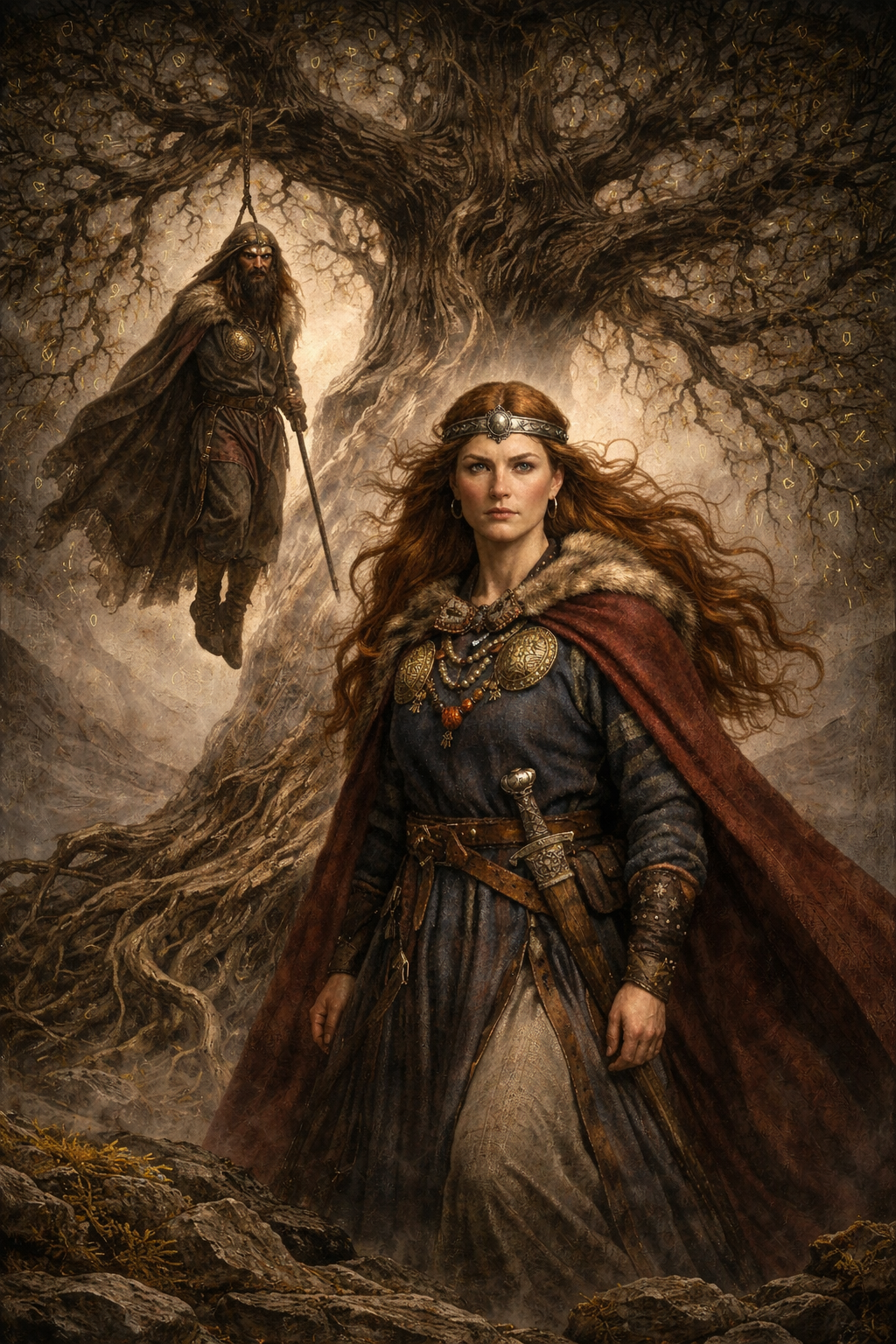
Óðinn, Hangadróttinn
"I ween that I hung on the windy tree,
Hung there for nights full nine;
With the spear I was wounded, and offered I was
To Othin, myself to myself,
On the tree that none may ever know
What root beneath it runs."
(Words of the High One, Håvamål)
One of the most intriguing figures of the 10th-century Norse world was Gunnhildr konungamóðir — literally “mother of kings.” She appears prominently in early sources such as Heimskringla, Egils saga, Fagrskinna and Ágrip, where she is described as the wife of King Eiríkr blóðøx (Eric Bloodaxe) and the mother of several men who became rulers of Norway, including Harald Greycloak.
Among the most discussed women of the late Viking Age is Gunnhild, known in the saga tradition as Gunnhildr konungamóðir — “Mother of Kings.” She appears in several early medieval sources, including Heimskringla, Egils saga, Fagrskinna, and the Latin chronicle Historia Norwegiae. These texts agree that she was married to Eric Bloodaxe and that several of her sons later claimed power in Norway. https://en.wikipedia.org/wiki/Gunnhild%2C_Mother_of_Kings?utm_source=chatgpt.com
Gunnhild lived during a formative and unstable period in Norwegian history, when regional rulers competed for dominance and the idea of a unified kingdom was still developing. After the death of Harald Fairhair, power in Norway was fragmented. Eric Bloodaxe, supported in part by his family network, attempted to consolidate rule. Gunnhild’s role in these political struggles is emphasized in saga literature, where she is portrayed as politically active, strategic, and influential in the succession of her sons.
According to Historia Norwegiae, Gunnhild may have been connected to the Danish royal house as the daughter of Gorm the Old, though other saga sources describe her as the daughter of a northern Norwegian chieftain named Ozur Toti. Modern historians consider both traditions as part of later narrative construction, and her exact origins remain uncertain. What is clear, however, is that she occupied a position close to royal authority and is consistently described as a central figure in dynastic politics.
The sagas — written in Christian Iceland centuries after the events — often portray Gunnhild as a powerful and sometimes feared woman. In some accounts, she is associated with sorcery or supernatural knowledge. Historians interpret these descriptions carefully, understanding that medieval writers sometimes used accusations of magic to frame politically influential pagan-era figures in dramatic terms. These literary elements reflect the storytelling culture of the period rather than verifiable historical evidence. https://sagadb.org/egils_saga.en
Gunnhild’s sons included rulers such as Harald Greycloak. Their reigns occurred during the decades when Christianity was gradually spreading in Norway, especially in regions such as Trøndelag. This was the same broader historical transformation that eventually led to the establishment of royal power in Trondheim and the development of the Christian center around Nidaros.
The political landscape in which Gunnhild operated was not peaceful. Kingship in the 10th century was often maintained through alliances, maritime warfare, and shifting loyalties among regional elites. The saga narratives describe exile, retaliation, and rivalry between royal factions. Whether all details are historically accurate is debated, but archaeological and textual evidence confirms that the period was marked by competition for control of coastal trade routes, fjords, and agricultural heartlands.
Importantly, Gunnhild’s reputation must be understood in context. Many medieval chronicles were written by clerical authors in a Christian environment. Powerful women from earlier pagan traditions were sometimes depicted as morally ambiguous or dangerous. This does not invalidate her existence or political influence; rather, it highlights how historical memory is shaped by the values of later generations.
From a modern perspective, Gunnhild represents a transitional era: the final phase of independent Viking power structures before stronger centralized kingship and Christian institutions reshaped Norway. She stands at the intersection of saga tradition, political consolidation, and cultural transformation.
When viewed alongside archaeological findings from Trondheim and the Trøndelag region — including early urban layers and church foundations — her story forms part of the broader narrative of how Norway moved from regional pagan power centers toward a Christian medieval kingdom.
Gunnhild remains one of the most debated figures of the Viking Age. Not purely legend, not fully documented biography — but a historically attested queen whose life reflects the complexity of late 10th-century Scandinavian politics. https://etheses.dur.ac.uk/13537/1/Whole_Absolute_Final.pdf?DDD17+=&utm_source=chatgpt.com
